
The Hidden Architecture of Crypto Liquidity: How Market Makers, Whales, and Fragmented Order Flow Shape Prices in 2026
The crypto market of 2026 projects an image of maturity: deeper order books, tighter spreads, and institutional-grade trading infrastructure.
But behind this neatly arranged façade lies a complex microstructure where liquidity is often an illusion, spreads widen instantly, and a small set of market makers dictate execution quality on both centralized and decentralized venues.
Despite the massive rise in trading volume on platforms hosting assets like Bitcoin and Ethereum, the real liquidity accessible to traders is significantly lower than public dashboards suggest.
This deep dive breaks down the unseen mechanics that drive modern crypto price formation.
1. Visible Liquidity vs. Executable Liquidity
Most traders look at:
- order-book depth at ±1%
- cumulative volume across exchanges
- 24h trading volume
However, these indicators represent visible liquidity, not executable liquidity.
Market makers routinely show “ghost size,” which disappears when touched, especially during volatile periods.
Three categories of non-executable liquidity
- Stale liquidity
Quotes that remain in the book but are too slow to update during volatility. - Conditional liquidity
Shown only if spreads remain within predefined thresholds. - Fleeing liquidity
Market makers cancel quotes when whales start unloading.
This means that a displayed $10M depth on a pair like BTC/USDT might translate to $1.5–3M of real, fillable liquidity.
2. The Market Maker Oligopoly
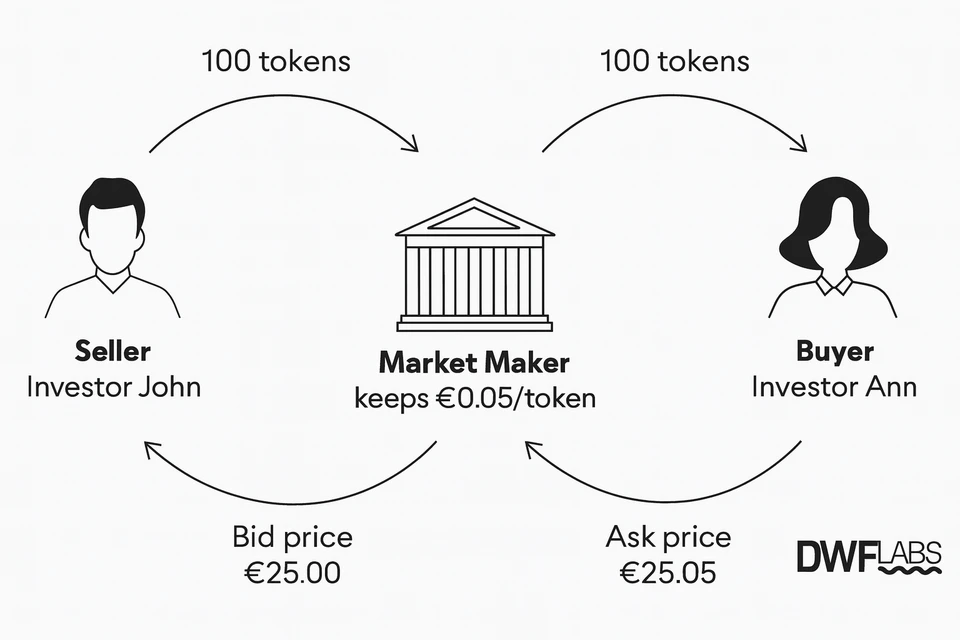
By 2026, 80–85% of liquidity on top centralized exchanges is supplied by:
- Jump Crypto
- Wintermute
- GSR
- Amber Group
- Cumberland
These firms:
- control spreads
- dictate liquidity levels
- arbitrage CEX/DEX price gaps
- influence volatility through quote-withdrawal patterns
Because most exchanges rely heavily on MMs, the market becomes synchronized: when one firm withdraws liquidity, the entire ecosystem feels the shock.
Result:
Liquidity is deep when nothing is happening — and shallow when traders need it most.
3. The Rise of Order-Flow Internalization
Unlike traditional finance where brokers internalize order flow, crypto exchanges now increasingly use:
- dark liquidity pools
- internal matching engines
- smart order routers
This means that a portion of the retail flow never touches the public order book at all.
Why exchanges do this
- to improve execution for market takers
- to reduce slippage
- to keep trading volume in-house
- to monetize flow by routing it to preferred MMs
Impact on price discovery
Public order books only show part of the picture, making volume-profile analysis and order-flow strategies less reliable than in 2020–2023.
4. Fragmentation Between CEX and DEX Liquidity
With AMMs, concentrated liquidity, and intent-based DEX designs, liquidity is now spread across dozens of venues.
Key fragmentation sources
- CEX spot markets
- CEX perpetual futures
- AMMs (Uniswap V3/V4, PancakeSwap, Curve)
- intent-based DEXes (CoWSwap, Anoma)
- L2 isolated liquidity (Arbitrum, Optimism, Base)
- liquidity-as-a-service protocols
Each venue has different pricing logic, meaning arbitrage bots, not traders, perform most price discovery.
This results in:
- highly reactive but unstable price formation
- sudden cross-venue slippage events
- micro-crashes when arbitrage fails or gas fees spike
5. Whales and the New Manipulation Playbook (2026 Edition)
Large holders shape the market much more effectively today due to:
- thinner real liquidity
- predictable MM behavior
- fragmented execution venues
- new long-tail DEX pairs with minimal oversight
- cross-venue leverage (perps, options, staking derivatives)
Common whale tactics
- Liquidity vacuum creation
Removing large resting bids to force MMs to widen spreads. - Trigger sweeping
Using small orders to activate stop-loss clusters. - Perp-driven spot manipulation
Moving perpetual markets to distort funding and spot prices. - Shadow accumulation via DEX intents
Buying large amounts without touching the visible order book.
Whales exploit the gaps between CEX and DEX microstructure, squeezing price without leaving obvious signatures.
6. The Myth of “Deep Altcoin Liquidity”
Platforms often claim deep liquidity for smaller assets like:
- new L2 tokens
- RWA protocols
- AI-crypto hybrids
- meme coins with 9–12 figure FDV
Reality:
Most of these markets are maintained by only one or two market makers, often funded by the token issuer’s treasury.
If an MM turns off its systems or loses its incentive:
- spreads widen 300–2000%
- slippage skyrockets
- chart shows abrupt “air gaps”
- small trades cause outsized moves
This is why small-cap tokens appear stable at first — then behave like illiquid microcaps during stress.
7. What Traders Should Actually Monitor (Not the Marketing Metrics)
Ignore:
- 24h volume
- CEX-reported liquidity tiers
- TVL as a proxy for liquidity
- AMM pool size without checking volatility exposure
Monitor instead:
- Order-book resiliency
How fast does liquidity refill after being consumed? - MM quote-cancellation frequency
High cancellation = unstable market. - Cross-venue spreads
The bigger the spread, the easier manipulation becomes. - Liquidity sensitivity to volatility
Does depth collapse when BTC moves >1%? - DEX price impact simulation
Tools like UniSim or custom slippage analysis reveal real liquidity. - Internalization ratio
High internalization = less transparent price discovery.
8. The Future: Intent-Based Liquidity & Autonomous Market Makers
2026 marks the start of a shift away from traditional order books.
Emerging frameworks
- autonomous liquidity managers (ALMs)
- intent-matching engines
- solver networks
- programmable liquidity rails
This architecture could finally deliver:
- more stable on-chain liquidity
- less reliance on centralized MMs
- more predictable execution for traders
But it also introduces new risks — including solver cartels and malicious routing.
The crypto market will become less manual, more automated, and more opaque unless transparency standards evolve.
Conclusion: Liquidity Isn’t What It Seems — But Understanding It Is a Superpower
The 2026 crypto environment is shaped by:
- a handful of market makers
- fragmented liquidity across dozens of venues
- hidden internalized flow
- whales exploiting microstructure inefficiencies
- AMMs creating synthetic (but unstable) depth
Traders who understand the difference between displayed liquidity and real liquidity gain a significant edge.
The market is deeper than ever — or at least, it looks that way.
In reality, liquidity is a constantly shifting mirage, controlled by invisible actors and fragile mechanisms.
To navigate it, you must look past the surface.