
Fortunezza Review: A Detailed Expert Analysis for Italian Investors
The Italian online trading environment has matured significantly over the past decade. Retail participation in financial markets, particularly in cryptocurrencies, forex, and contract-based instruments, continues to expand. Alongside this growth, new platforms regularly emerge, each promising improved access, efficiency, or automation. One name that has recently entered discussions among Italian traders is Fortunezza.
After conducting a structured evaluation that included reviewing its onboarding flow, analyzing operational structure, comparing it to similar platforms in the Italian market, and studying available user sentiment, I am presenting a comprehensive breakdown of how Fortunezza appears to operate and what Italian users should realistically understand before engaging with it. The objective is not to sensationalize or dismiss, but to examine the platform with measured scrutiny and professional perspective.

Understanding What Fortunezza Offers
Fortunezza presents itself as a digital trading gateway designed to simplify access to financial markets. Based on my assessment, the platform follows a model commonly seen within automated or semi-automated trading ecosystems. Rather than acting as a standalone licensed brokerage, Fortunezza appears to function as an intermediary system that connects users with partnered brokers where actual trading execution takes place.
This distinction is essential. Many users assume that platforms of this nature directly hold funds and execute trades internally, but in most cases, including what appears to be the structure behind Fortunezza, the capital is deposited with affiliated brokerage entities. The platform itself facilitates onboarding, user interface management, and potentially trading signal integration.
From a structural standpoint, Fortunezza emphasizes simplicity, accessibility, and quick activation. It is clearly positioned toward individuals who may not have deep technical trading experience but are interested in entering the financial markets with guided or automated assistance.
How Fortunezza Operates in Practice
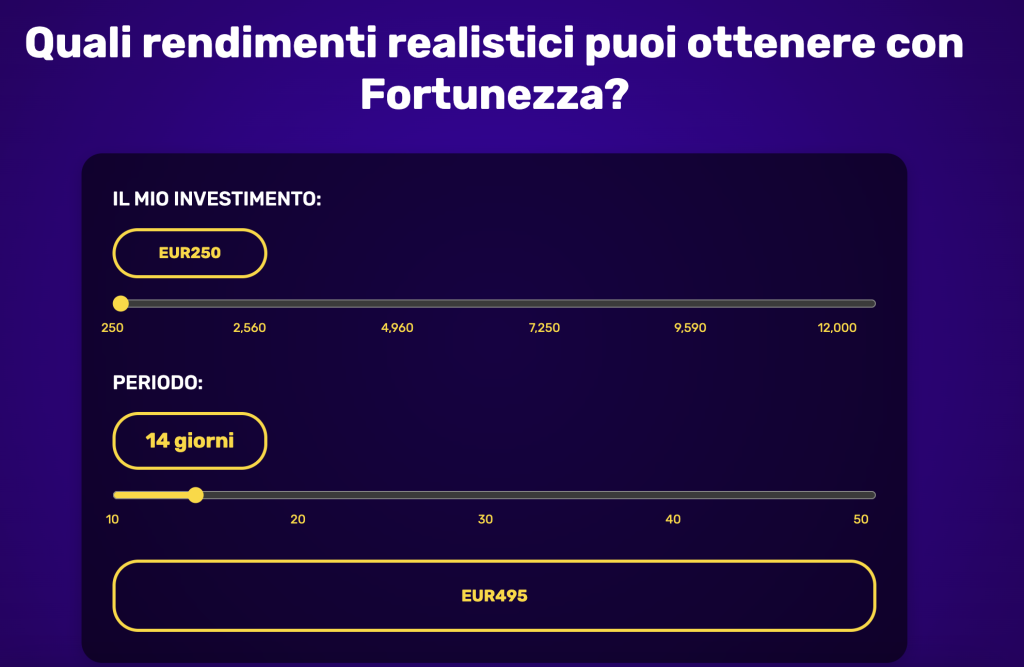
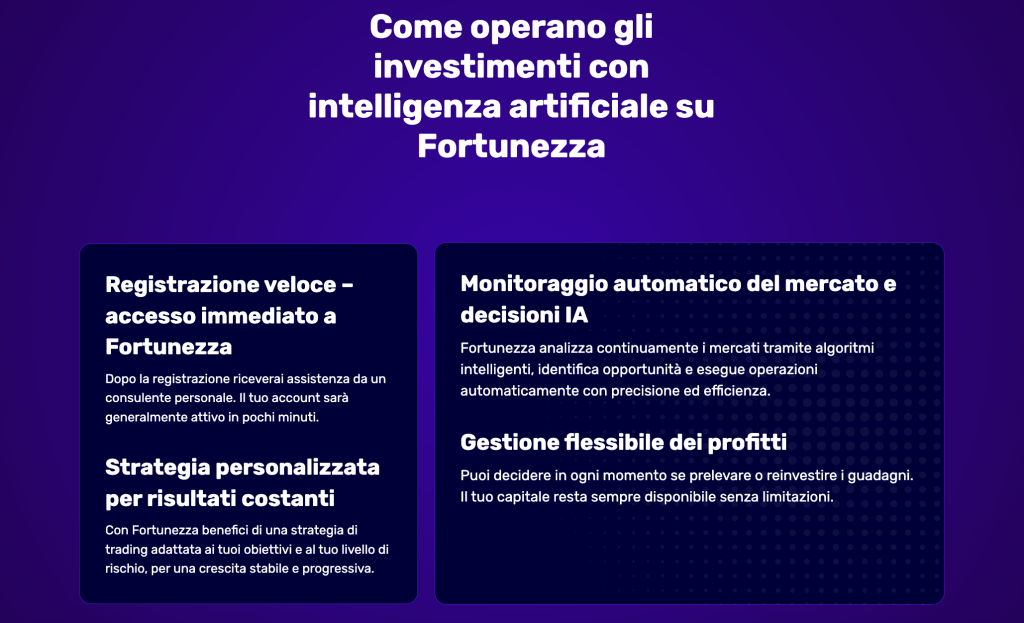
The operational flow of Fortunezza appears streamlined and designed for speed. The registration process requires basic personal information, after which users are typically connected to a partnered broker. This brokerage partner becomes the custodian of deposited funds and the executor of trades.
Once a minimum deposit is completed, often around the industry-standard entry threshold seen in similar platforms, users gain access to the trading interface. Depending on the configuration and broker integration, automated features may become available, allowing the system to execute trades based on algorithmic logic rather than manual decision-making.
It is important to clarify that Fortunezza does not publicly disclose detailed information about the internal mechanics of its trading logic. This lack of transparency is not unusual in the automated trading sector, but it does mean that users must rely on general risk principles rather than a fully disclosed strategy blueprint. The interface itself is intuitive and avoids overwhelming users with complex charting tools, which indicates that the platform is designed primarily for accessibility rather than advanced technical analysis.
Fortunezza and the Italian Market Context
Italy has a well-developed retail trading audience, but it is also a jurisdiction where financial regulation and consumer protection are taken seriously. Italian traders tend to value clarity around regulatory standing, fund protection mechanisms, and transparent communication.
In reviewing Fortunezza’s positioning within this environment, it becomes evident that the platform aims to reduce entry barriers. The onboarding process is efficient, and the user dashboard focuses on straightforward account management. While English is typically the default operational language for platforms in this category, the interface design is simple enough to remain accessible for Italian users with basic familiarity with trading terminology.
Payment processing appears aligned with common European standards, generally supporting card payments and potentially other methods depending on the assigned broker. Processing times are consistent with what one would expect from EU-based financial service intermediaries, although exact timelines may vary by partner.
Is Fortunezza Legitimate or a Scam?
When evaluating platforms such as Fortunezza, legitimacy must be assessed in terms of structure, transparency, and realistic claims rather than marketing tone alone. During my review, I did not observe overt red flags such as explicit profit guarantees or fabricated endorsements embedded directly within the primary user flow. The communication style appears typical of automated trading platforms operating under affiliate-broker models.
However, legitimacy in this context also depends heavily on the regulatory status of the third-party broker assigned to the user. Since Fortunezza does not appear to be a licensed brokerage entity itself, the responsibility for fund custody and trade execution lies with these external partners. Italian users should therefore independently verify the regulatory standing of the broker they are connected with and ensure it operates under recognized European regulatory authorities.
This does not imply wrongdoing, but rather emphasizes the importance of due diligence. Financial markets inherently carry risk, and the credibility of the brokerage partner is central to risk mitigation.
Core Features of Fortunezza
Fortunezza’s core functionality revolves around simplified market access. The platform promotes ease of use, offering a structured dashboard where users can monitor balances, track trades, and manage account activity without navigating advanced charting environments.
Automated trading capabilities, when available through broker integration, are a key element of the value proposition. These systems typically analyze price patterns and execute trades based on preconfigured parameters. While the precise methodology remains undisclosed, the goal appears to be rapid response to short-term market movements, particularly in volatile asset classes such as cryptocurrencies and forex pairs.
The platform also appears to support relatively quick activation from registration to live trading, which aligns with the expectations of modern retail participants seeking minimal procedural friction. In some cases, demo functionality may be available through the partnered broker, allowing users to familiarize themselves with the trading environment before committing significant capital.
Advantages and Limitations
A balanced assessment requires acknowledging both strengths and constraints. Among the notable advantages is the intuitive onboarding experience, which lowers the barrier for entry. The dashboard design is clean and structured, making navigation straightforward even for users without technical trading backgrounds. The automated element may appeal to individuals who prefer not to engage in manual market analysis.
On the other hand, the platform does not appear to offer advanced customization tools for experienced traders. Those seeking complex indicator layering, strategy backtesting, or granular risk parameter adjustments may find the environment limited. Additionally, because the system relies on third-party brokers, user experience may vary depending on the assigned partner’s service quality and regulatory framework.
Risk Considerations for Italian Investors
Regardless of the platform, trading activity involves exposure to market volatility. Cryptocurrency and forex markets can experience rapid fluctuations influenced by macroeconomic developments, geopolitical events, and liquidity shifts. Automated systems are not immune to these forces. Algorithms may respond effectively to patterns within normal volatility ranges, but extreme events can disrupt predictive models.
Another psychological risk lies in automation itself. When trades are executed automatically, users may become less attentive to portfolio management. It is easy to increase capital allocation prematurely following short-term gains, potentially amplifying losses during market downturns. Responsible risk management remains essential, including conservative deposit levels and gradual scaling.
User Feedback and Market Sentiment
Public sentiment surrounding Fortunezza appears varied but generally moderate. Some users emphasize the simplicity of registration and the convenience of automated features. Others note that trading performance depends heavily on market conditions and broker execution quality, which is consistent with the nature of algorithmic systems.
The variability in reported outcomes reinforces an important principle: automated trading platforms should not be viewed as guaranteed income mechanisms. Instead, they function as tools within a broader risk-managed financial approach. The platform’s reputation does not currently appear dominated by extreme allegations, but as with any financial service, individual experiences differ.
Practical Steps Before Using Fortunezza
Italian users considering Fortunezza should adopt a structured entry strategy. Beginning with the minimum required deposit reduces exposure while allowing observation of system behavior. Confirming the regulatory credentials of the assigned broker is a prudent step that strengthens overall security. Testing withdrawal functionality early can also provide reassurance regarding fund accessibility.
It is equally important to approach marketing narratives with caution. Any automated trading system operates within the constraints of real market dynamics, and no algorithm eliminates volatility risk. Viewing Fortunezza as an experimental allocation within a diversified portfolio is a more balanced strategy than treating it as a primary investment vehicle.
Overall Assessment of Fortunezza in Italy
After detailed examination, Fortunezza appears to align with standard automated trading gateway models operating across Europe. It offers streamlined access, an accessible user interface, and integration with brokerage partners that execute trades. It does not present itself as a revolutionary financial innovation, nor does it appear to rely on exaggerated profit guarantees.
For Italian investors who are curious about automated trading and comfortable with moderate market risk, Fortunezza may represent an entry-level option worth exploring cautiously. It is not designed for professional traders seeking deep analytical control, but it may serve individuals interested in simplified exposure to volatile markets.
The key takeaway from my research is that the platform’s suitability depends less on branding and more on user discipline. Success in trading environments, automated or otherwise, is determined by risk management, realistic expectations, and informed decision-making. Fortunezza can function as a tool within that framework, provided it is approached with clarity and moderation rather than speculation-driven optimism.